Understanding monitor results
The website monitor provides a comprehensive view of the tracking technologies active on your website. After a scan is complete, the results are presented in the Action Center, organized by the monitor that detected the assets. Each monitor will have its own row in the action center.
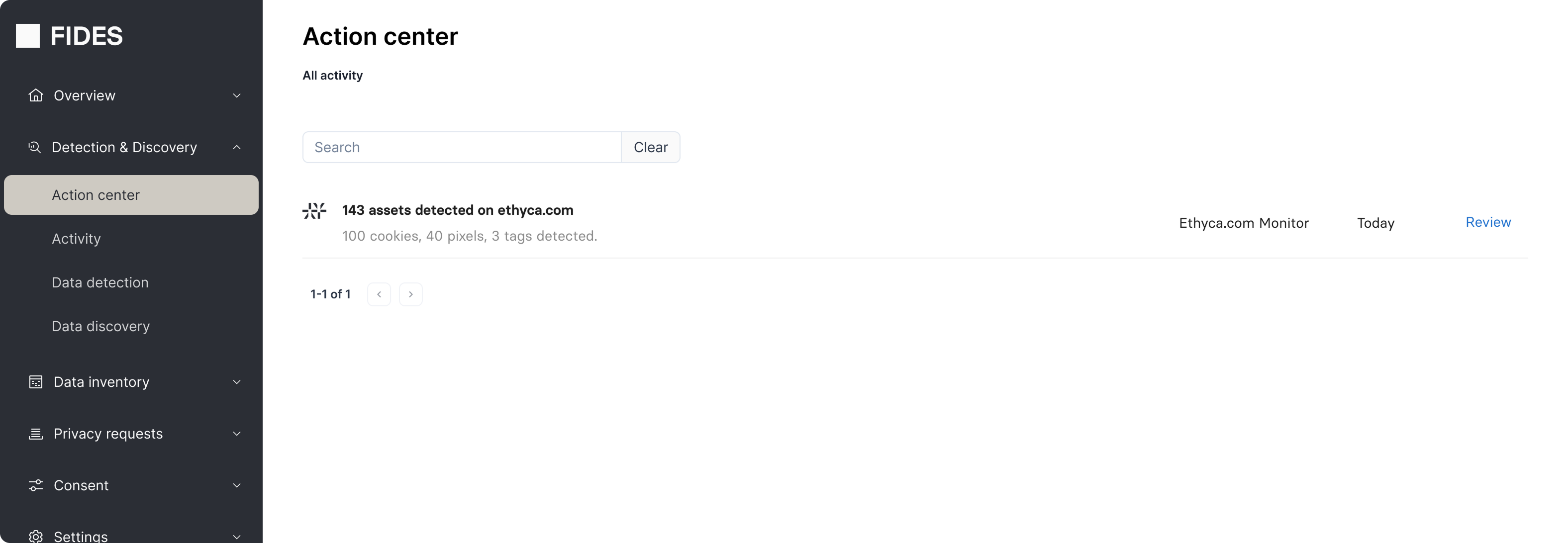
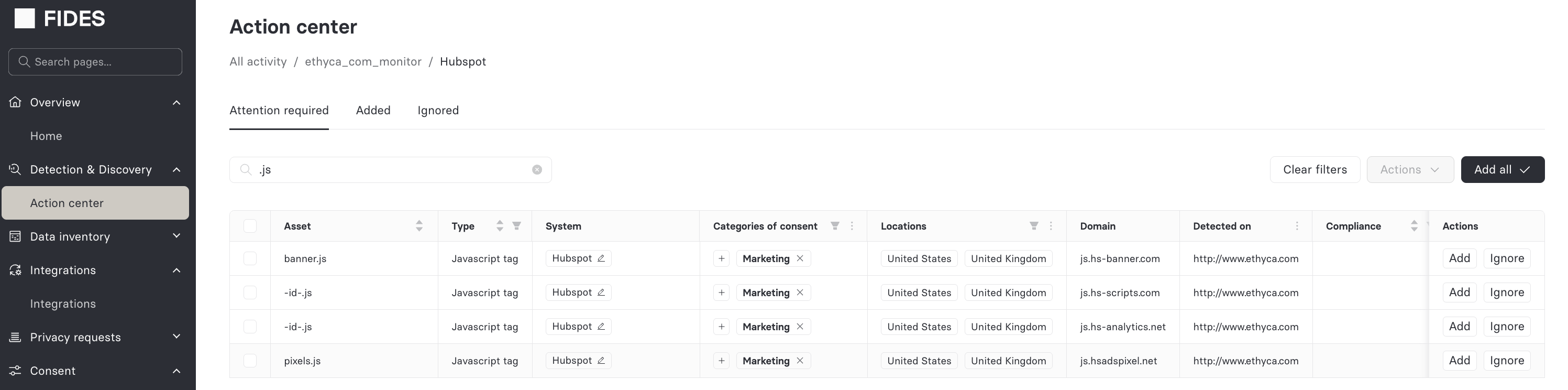
After selecting the desired monitor in the action center, you’re brought to a table of all assets grouped by system/vendor. In this view you can add or ignore assets associated with a single system or bulk add/ignore multiple systems. Select a system to see a list of assets associated with that system.
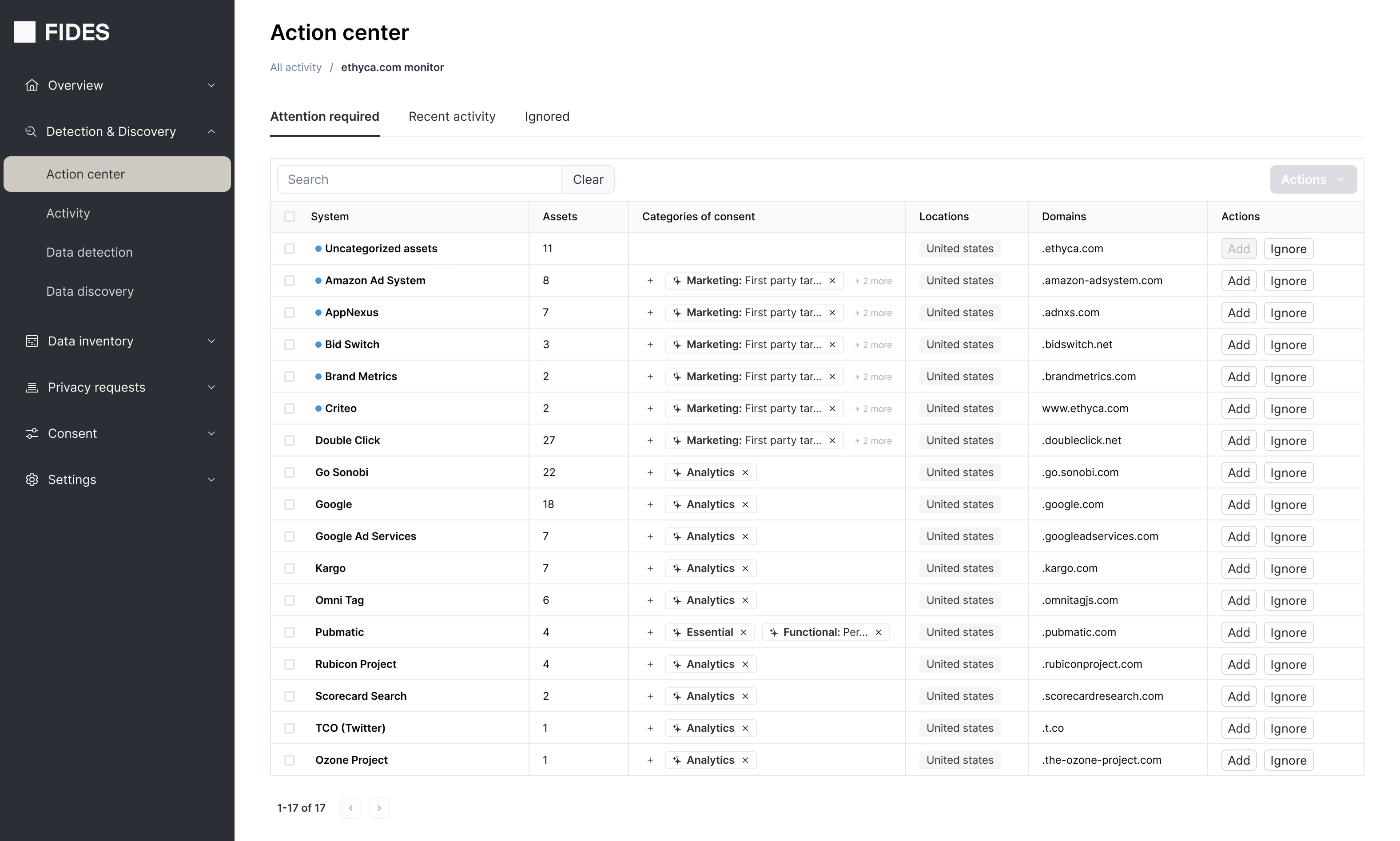
For each detected asset (cookie, pixel, tag, JavaScript), the following information is provided:
- Asset name: The name of the asset (e.g., the cookie name).
- Type: The type of asset (e.g., cookie, pixel).
- System: The system/vendor responsible for serving the asset (e.g., Google Ads)
- Categories of consent: A classification of data processing activities based on the level and type of user consent required (e.g., Essential, Functional, Analytics, Marketing). By default, these are inferred from the system to which the asset belongs
- Locations: Geographic regions where the asset is detected, important for understanding varying privacy regulations.
- Domains: The web address associated with the asset, revealing whether the website owner (first-party) or an external vendor (third-party) controls its use and data.
- Pages detected on: Specific website pages where the asset is found, helping to understand the context of its usage. This column is only visible when viewing individual assets.
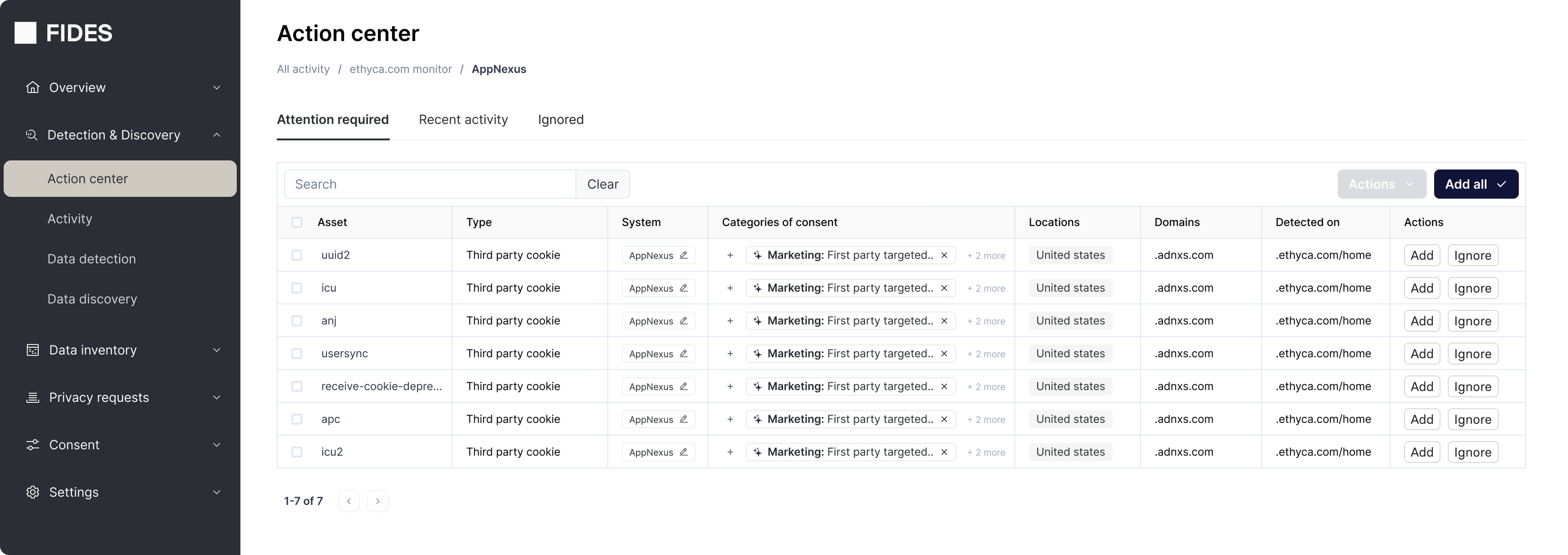
Assets are categorized automatically using the Astralis dictionary. If a system is not found in the dictionary, it will be placed in the "Uncategorized Assets" group, requiring manual categorization.
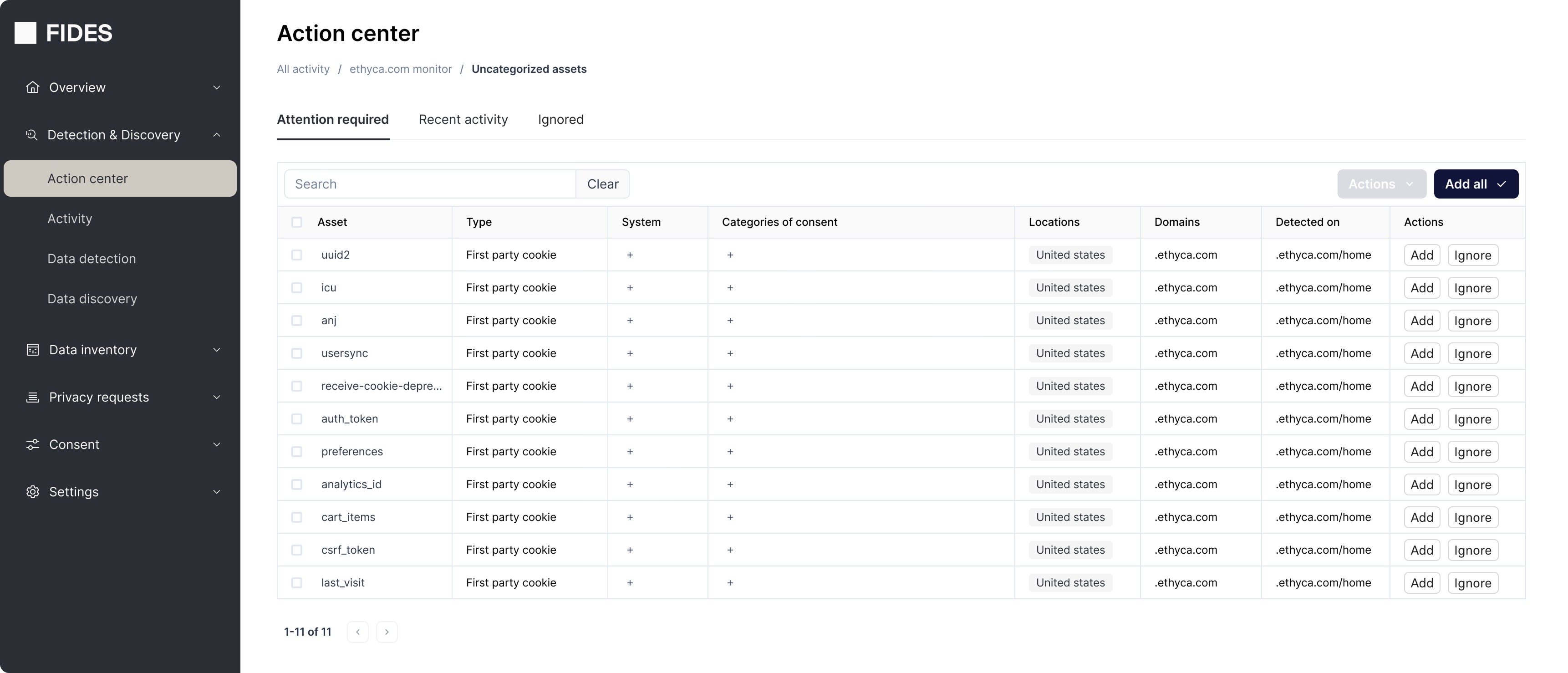
Recent activity
After adding an asset to the system inventory, the asset will move out of the "Attention required" tab and over to the "Recent activity" tab. Note that the "Recent activity" tab shows the most recently added assets for this monitor across all systems.
Generate a PDF report
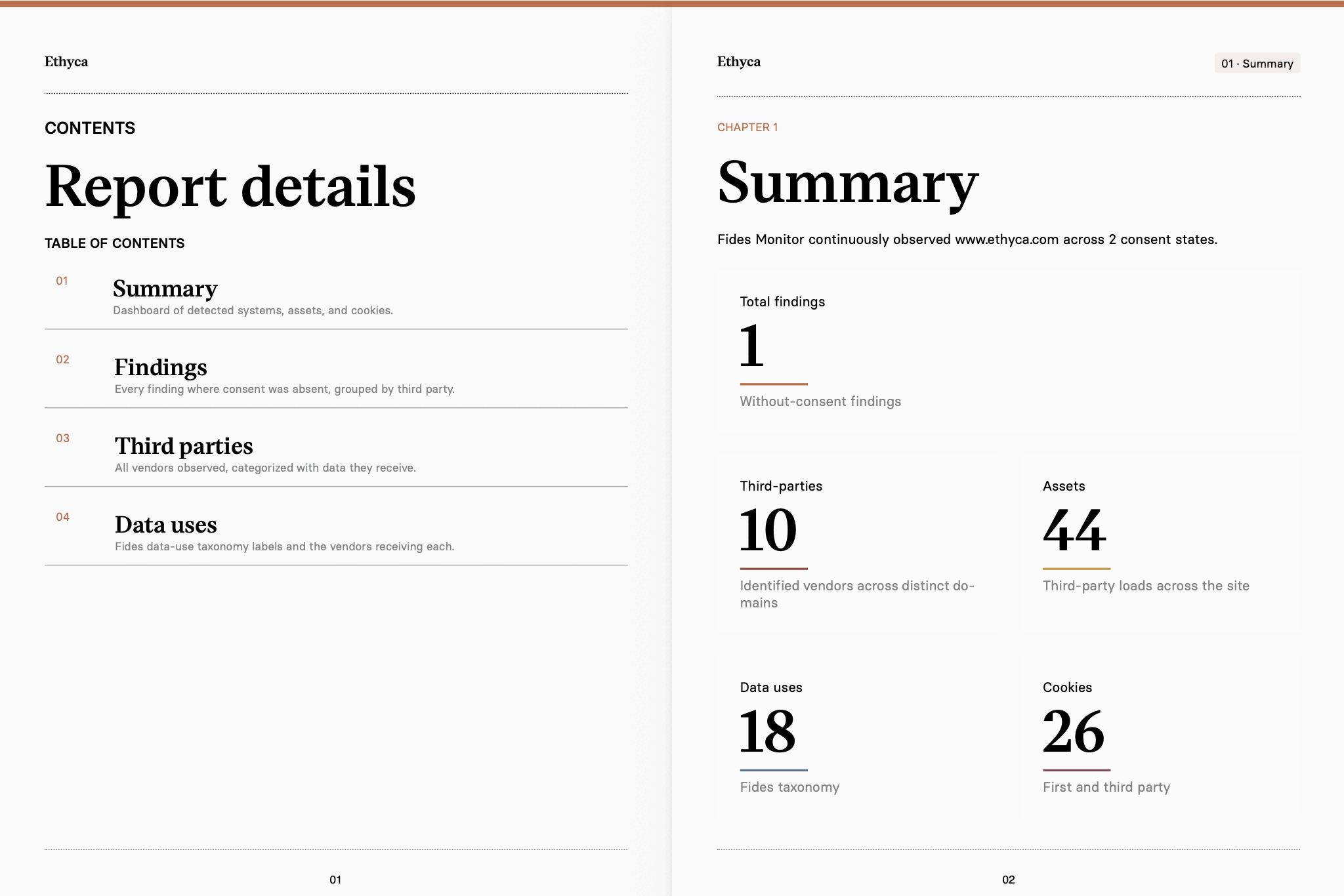
From the Action Center, select the Generate report icon to download a PDF that summarizes the monitor's findings, including how your site behaves before and after a visitor consents and any consent issues the monitor detected — a shareable record for stakeholders outside of Astralis.
Consolidated assets
Many cookies, network requests, and subdomains carry a unique, dynamic identifier — a session ID, user ID, request hash, or similar. Left as-is, each of these would surface as a brand-new asset on every scan (for example, a different cookie for every visitor), flooding your results with effectively duplicate entries that all represent the same underlying technology.
To prevent this, the website monitor normalizes asset identifiers. It detects the dynamic portion of a cookie name, URL path, or subdomain and replaces it with an -id- placeholder. Assets that normalize to the same value are then rolled up into a single representative result — a consolidated, or wildcard, asset.
A few examples of how identifiers are normalized:
| Detected values | Consolidated asset |
|---|---|
_ga_18MY9V5RLC, _ga_CWILS0SXPK | _ga_-id- |
cid_8f4d24c67aef4fc5abc7ddd590a3299e | cid_-id- |
https://js.hs-scripts.com/19834782.js | https://js.hs-scripts.com/-id-.js |
abc123.cdn.example.com | -id-.cdn.example.com |
The monitor only collapses the parts of an identifier that look machine-generated — UUIDs, long hexadecimal or alphanumeric tokens, and runs of digits — while leaving stable, human-meaningful names untouched (for example __Secure-ROLLOUT_TOKEN, eupubconsent-v2, and ordinary subdomains like www). A consolidated asset stands in for every concrete variant that was rolled up into it, so categorizing or adding the wildcard once covers all of them.
-id- placeholder in its name. Adding or ignoring it applies to every matching variant for that monitor — see Taking action on monitor results.Upgrade handling
Asset consolidation was introduced after some environments had already run scans, so you may have existing assets that were captured under their original, per-ID names (for example 100796X1589914.skimlinks.js). When the monitor is upgraded and the next scan reports the consolidated form instead (-id-.skimlinks.js), Astralis automatically reconciles the older assets so you don't end up triaging the same technology under both its old and new names:
- Assets not yet added to your inventory are superseded by the incoming consolidated asset and removed. There's nothing to migrate — the next scan simply replaces the per-ID entries with the single wildcard asset.
- Assets you've already added (monitored assets) are left untouched during a scan. They're only folded into a wildcard when you explicitly add a matching consolidated asset, which surfaces a confirmation step first (see Taking action on monitor results).
This cleanup happens automatically as scan results are ingested; no manual migration is required.