.png?w=1920&h=1008&auto=format)
Benefits of Data Governance: The ROI is Better Than You Think
Most organizations treat data governance as a compliance checkbox and miss what it actually delivers. This article unpacks where the ROI shows up — from $12.9M in avoided bad-data costs to faster DSR cycles, unblocked AI initiatives, and enterprise deals won on demonstrable trust.

Key Takeaways
- Poor data quality costs organizations $12.9M per year on average. Governance that operates at the infrastructure level stops bad data at the source.
- Data professionals routinely cite data preparation as their most time-consuming task. Structured governance flips that ratio and compounds productivity across every team.
- AI models inherit every gap in their training data. Without governance over consent, classification, and legal basis, AI risk scales automatically with every output.
- Governance programs fail when they stop at the policy layer. Runtime enforcement, not dashboards and tickets, is what separates programs that deliver ROI from programs that generate reports.
- The ROI is both near-term and long-term. Process efficiency shows up immediately; the ability to launch AI, enter regulated verticals, and scale without proportional headcount growth shows up over time.
Most organizations treat data governance as a compliance exercise: a privacy policy here, a consent banner there, a quarterly audit to keep legal satisfied. That framing is costing them more than they realize.
The organizations making the most of their data are not doing it because they have better models or bigger teams. They are doing it because they have built governance into how their data infrastructure actually operates. The benefits of data governance extend well past regulatory checkboxes. When governance is embedded at the infrastructure level rather than layered on top of existing systems, it becomes a capability that enables faster decisions, more reliable analytics, and AI initiatives that scale without introducing new exposure.
The ROI is measurable, and in most cases it is substantially better than organizations expect before they begin.
This piece breaks down what those benefits look like in practice, where the business value shows up, and why governance programs that operate only at the policy level tend to fall short before they deliver any of it.
Why Data Governance Has Become a Strategic Priority
Data governance didn't become a boardroom topic because executives suddenly developed an interest in data hygiene. It became one because the stakes changed.
Three forces have accelerated this shift:
- Data volumes scaled past what manual oversight can manage: The explosion in connected systems, third-party integrations, and real-time data flows has made point-in-time governance frameworks obsolete almost as soon as they're documented.
- Privacy regulations expanded dramatically: 79% of the world's population now lives under some form of privacy law, with GDPR, CCPA, and the EU AI Act setting increasingly specific obligations around how data is collected, processed, and used.
- AI adoption moved governance from a consideration to a critical dependency. AI systems consume data continuously.. Every problem in that data compounds automatically with every output the system produces. That is precisely why AI amplifies every existing data governance problem, and without structural governance in place, that gap only widens over time.
The result is that organizations without structural governance aren't just facing compliance exposure. They're dealing with unreliable data, blocked AI initiatives, and a widening gap between the speed at which their systems consume data and the speed at which their teams can validate it.
Data governance, when it works, addresses this at the root. It defines who owns data, how it's classified, what it can be used for, and how those rules are enforced across every system that touches it. That is not a compliance program.
Top Data Governance Benefits That Can't Be Overlooked
The case for governance isn't theoretical. Each of the following benefits represents a measurable operational outcome that organizations see when governance moves from documentation into practice.
Bad Data Costs $12.9M/Year. Governance Stops It at the Source
The most foundational benefit of governance is also the most underestimated: reliable data.
Without standardized definitions, data stewardship, and validation processes, different teams routinely work from different versions of the same dataset. Reporting inconsistencies, analytics errors, and downstream model failures often trace back to this single gap. The financial impact is significant: poor data quality costs organizations an average of $12.9 million per year, and the U.S. economy loses an estimated $3.1 trillion annually to bad data.
Governance programs that define shared data standards across systems close this gap. When a field means the same thing in every context, when data is tagged at the source with classification metadata, and when those tags follow the data wherever it moves, error rates drop and confidence in outputs rises. For organizations managing large data estates, the operational savings from eliminating bad data typically outweigh the cost of the governance program itself.
Helios, Ethyca's data inventory and classification product, addresses this by keeping discovery live so that data maps reflect reality rather than the last time someone ran a manual audit.
Enforce Compliance Automatically Without Manual Systems
Regulatory compliance is where governance programs often start, but the practical benefit goes further than avoiding fines. It is about replacing reactive, audit-driven compliance with systematic, built-in enforcement.
When governance is embedded into infrastructure, the organization can demonstrate compliance because its systems enforce it, not because someone prepared a manual report before an audit. This matters for:
- GDPR Article 30 records of processing activities
- CCPA data subject rights response windows
- EU AI Act training data documentation requirements, which took effect in August 2025 with penalties reaching up to 3% of global annual revenue for non-compliance
Governance also builds a defensible audit trail. When regulators ask how a specific dataset was used, by whom, and under what legal basis, infrastructure-level governance produces an answer automatically. Manual programs produce a search.
For multinational organizations, the compliance picture grows more complex. GDPR requirements, CCPA obligations, HIPAA controls, and the EU AI Act do not always align. Managing them through separate manual programs is operationally expensive and creates gaps where jurisdictions overlap or conflict. Governance infrastructure that codifies rules once and enforces them consistently across all systems, regardless of jurisdiction, removes that duplication and the risk it creates.
Analysts Spend 80% of Their Time Prepping Data. Governance Flips That Ratio
Governed data makes analytics teams faster. For most data-intensive organizations, this is one of the largest direct ROI drivers.
When datasets are well-defined, documented, and accessible through a shared taxonomy, analysts spend less time validating data before working with it. The research and validation overhead that consumes a meaningful portion of analytics cycles shifts from manual effort to automated infrastructure. Teams move from question to insight faster, with higher confidence in the outputs. For organizations where data science resources are constrained, the time savings alone justify the investment.
The compound effect is significant: when analysts trust the data, they build on it. Dashboards get used, models get deployed, decisions get made. When analysts do not trust the data, they build workarounds and shadow systems, making the governance problem worse over time.
The hidden cost of low data trust shows up in long data preparation timelines, in analysts who won't commit to numbers without extensive caveats, and in executives who've been burned by conflicting reports and have stopped relying on data teams to drive decisions. Governance restores that credibility, and the productivity gains that follow are real.
When Data Lineage Is Visible, Teams Stop Relitigating Numbers in Meetings
Analytics quality and organizational trust in data are directly linked. When different departments produce different numbers from the same source, the downstream effect goes beyond confusion: decision-makers discount data they do not trust and fall back on instinct. Governance breaks this pattern.
When data lineage is visible, when definitions are shared across teams, and when the provenance of a dataset is traceable, stakeholder confidence improves. The practical outcome is faster decision cycles and more consistent strategic alignment across functions. Teams stop relitigating data quality in meetings and start using data to drive them.
This benefit has an organizational dynamic that often goes unaddressed. Data trust is not evenly distributed across companies. Typically, a small number of analysts or data engineers hold deep institutional knowledge about which datasets are reliable and under what conditions. When those people leave or change roles, that knowledge leaves with them.
AI That Scales Without Creating New Risks
AI models are only as reliable as the data they're trained on. If that data carries unresolved consent status, ambiguous legal basis, or incomplete classification, those gaps propagate into every output the model produces. This is the governance challenge that AI teams are increasingly confronting head-on.
Training datasets assembled without clear documentation of their provenance, consent basis, and access permissions create liability at the point of use — not just at the point of collection. For organizations operating under the EU AI Act, the exposure is regulatory. For organizations deploying AI in consumer-facing products, the exposure is reputational and commercial.
The governance infrastructure required for responsible AI is not separate from data governance. Organizations that have built strong foundational governance find that expanding it to cover AI use cases is systematic rather than disruptive. Those that haven't faced an architectural problem when AI initiatives scale.
Ramp, which processes $55B+ in annual payments, built its governance infrastructure as code-based, engineering-owned infrastructure from the start. Privacy Counsel Michael Razeeq explained the forward-looking logic: "Data is key to AI being successful. Being able to tag data in a way that makes it useful and easier to track helps to lay the groundwork for more successful AI deployments."
For a deeper look at how AI amplifies every existing gap, see The AI Risk Multiplier.
Engineering Starts Owning Policy. DSR Cycles Drop From 7 Days to 48 Hours
Clear data ownership, standardized processes, and shared classification language reduce the friction that accumulates between teams working on the same data. The efficiency gains appear in two places: reduced duplication of effort among data producers and consumers, and faster cross-functional collaboration when shared governance standards mean teams are already aligned.
After implementing automated governance infrastructure across four petabytes of user data, SurveyMonkey's engineers began participating directly in policy modeling alongside legal and privacy teams. VP of Infrastructure and Security Engineering Craik Pyke described the result: "People in engineering know what a RoPA is. They understand policy around data minimization. We've learned a lot."
The governance infrastructure removed the translation layer that had been doing that. DSR response cycles dropped from seven days to 48 hours. Read the full SurveyMonkey case study for the complete breakdown.
Customer Trust as a Measurable Asset
Enterprise procurement decisions increasingly include data governance due diligence. Buyers want to know how vendors handle their data, what happens when a subject access request arrives, and whether the vendor can demonstrate auditable consent practices across systems. Organizations with structural governance can answer these questions clearly and that ability becomes a compounding commercial advantage over time.
The link between demonstrable data practices and enterprise deals shows up in procurement questionnaires, security assessments, and the ability to close business in regulated verticals like financial services, healthcare, and government.
SurveyMonkey's trajectory is instructive. As the company expanded into enterprise accounts in healthcare and financial services, the compliance bar it needed to meet across its entire platform rose significantly. The governance infrastructure it built with Ethyca did more than satisfy that requirement. It became a proof point in enterprise sales conversations. Craik Pyke, VP of Infrastructure and Security Engineering at SurveyMonkey, put it plainly: "Privacy-led design is becoming a more critical determining factor for companies."
Reduced Exposure Across Security, Compliance, and Breach Risk
The mechanism is direct: when data practices are systematic and enforceable, audit preparation becomes a report rather than a project. When data access is governed by purpose-based rules rather than broad role-based permissions, the attack surface for external breaches and internal misuse shrinks.
Governance is a direct risk reduction mechanism with measurable impact on breach probability, audit outcomes, and remediation cost. It is not an abstract control function.
See How Ethyca Builds Governance Into Your Infrastructure
From data classification and inventory to consent enforcement and AI policy control, Ethyca builds governance that runs inside your systems, not alongside them.
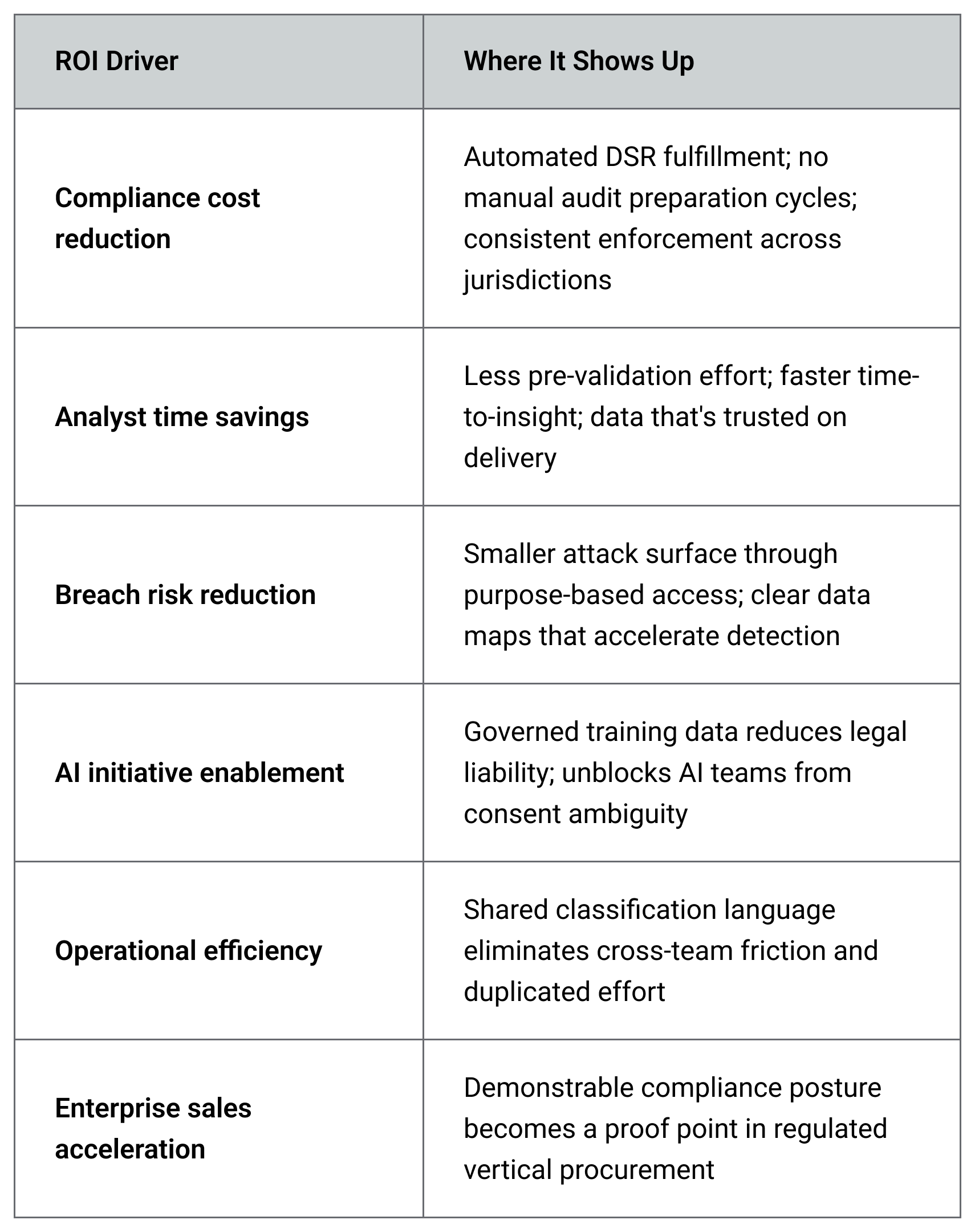
Data Governance ROI: Where the Business Value Shows Up
The ROI of data governance is not abstract. It shows up in specific, measurable places. Below is where enterprises consistently find it:
.png?w=1200&h=1516&auto=format)
The financial case compounds over time. Organizations that build governance early avoid the exponentially harder remediation cost of retroactively governing a scaled data estate.
Ethyca's platform has saved customers $74M+ through automation, processed 4M+ access requests, and managed 744M+ preferences annually across 200+ global brands.
Those figures represent actual business value that would otherwise require significant manual effort, operational headcount, or both. The question for most organizations is not whether governance delivers ROI. It is whether their current program is structured to capture it.
It's also worth separating near-term from long-term ROI:
- Near-term: Process efficiency. Faster DSR cycles, less analyst validation overhead, and fewer compliance incidents requiring remediation.
- Long-term: Capability. The ability to launch AI initiatives on a trusted data foundation, enter regulated verticals with a demonstrable compliance posture, and scale data operations without a proportional increase in governance headcount.
Organizations that invest only to capture near-term efficiency often underestimate what the long-term capability gap will eventually cost them.
Why Most Governance Programs Struggle With Implementation
The failure mode is consistent across organizations: governance gets documented, ownership gets assigned on paper, and then day-to-day data operations proceed as if none of it exists. Three failure patterns account for the majority of stalled programs:
1. Unclear ownership in practice Assigning a data steward in a policy document is not the same as engineering accountability into workflows. When every data use case requires a human sign-off, the process doesn't scale beyond small teams and simple systems.
2. Fragmented systems Consent recorded in one system but not propagated to the systems that actually process data creates an enforcement gap that no policy document can close. The same problem affects classification: data catalogues updated manually fall behind operational reality within weeks.
3. Governance that stops at the policy layer Dashboards and tickets are useful tools, but they are not sufficient for enforcement. Runtime governance, where controls operate at the moment data is accessed or used rather than reviewed after the fact, is what separates programs that deliver outcomes from programs that generate reports and nothing else.
Addressing these gaps requires thinking about governance the same way engineering teams think about infrastructure: as something that must be built into systems, not wrapped around them.
How to create a data governance framework is a practical starting point for understanding what that operational layer requires. The AI accountability gap that many organizations are now confronting traces directly back to these same structural weaknesses.
How Ethyca can you realize the benefits of data governance
The ROI of good data governanceI is real and it shows up in specific line items: compliance costs reduced, analyst hours reclaimed, breach risk lowered, AI initiatives unblocked. What determines whether an organization captures that value is not the quality of its governance policy. It is the depth at which that policy is enforced across actual data systems.
Ethyca embeds governance directly into data infrastructure rather than layering it on top:
- Fides, the world's most-used open-source privacy engineering platform, codifies policy once and enforces it automatically across every system and AI pipeline.
- Astralis extends that enforcement to the point of AI data use, so governance travels into training and inference workflows rather than stopping at the pipeline boundary.
- Helios keeps data discovery live, so your data map reflects operational reality rather than the last manual audit.
For organizations ready to move from governance as documentation to governance as infrastructure, our AI governance resource is a useful read on how AI scale is redefining what data readiness actually requires. When your data carries its context, speed and safety stop being tradeoffs.
.png?rect=534,0,2133,2133&w=3200&h=3200&fit=min&auto=format)

.png?rect=534,0,2133,2133&w=3200&h=3200&fit=min&auto=format)
.png?rect=534,0,2133,2133&w=3200&h=3200&fit=min&auto=format)
.png?w=3200&h=2133&auto=format)
.png?w=3200&h=2133&auto=format)