
Move from data visibility to action.

Breadth and depth are different architectural choices.
Securiti AI's ambition is a single platform for all data intelligence and controls. Ethyca's is a single open standard that makes privacy enforceable — by legal teams, engineering teams, and the infrastructure they share.
Securiti AI
A unified enterprise command center across data security, privacy, and governanceSecuriti AI's Data Command Center provides discovery, classification, data mapping, DSR automation, consent management, DSPM, AI governance, and compliance workflows in a single platform. It serves security teams, privacy teams, governance teams, and compliance teams with a broad connector base across hybrid multicloud environments.
For large enterprises seeking to consolidate fragmented point tools under one roof, that approach has genuine appeal — and Securiti earned its Forrester Wave leadership on the strength of that breadth. The platform's depth on data discovery and classification in particular is well-regarded.
→ Strong discovery, classification, and multicloud coverage
Ethyca
A platform that serves everyone equally serves no one in particularBreadth across security, privacy, and governance means every team gets a module — but no team gets the infrastructure they actually need to enforce policy in their own work. Engineers have no Fides-equivalent CLI or CI/CD tooling. Legal teams have no shared open taxonomy. The command center gives you a view. It doesn't give you an enforceable standard.
Add the Veeam acquisition context: Securiti is now part of a $1.725B bet on combining data backup with data governance. That's a legitimate enterprise story. It's not a privacy-engineering story. For organizations whose primary challenge is making privacy enforceable at the system and pipeline level, the roadmap that follows an acquisition by a data resilience company points in a different direction.
→ Enforcement requires depth in one domain, not breadth across five

Companies building trust into data with Ethyca
What a command center can't give you.
A platform built for breadth across security, privacy, governance, and compliance faces inherent tradeoffs. The gaps that matter most show up in the places where enforcement — not visibility — is required.
Complex setup requiring dedicated resources
Reviewers consistently document that Securiti requires significant initial configuration and dedicated staff to implement effectively. One common pattern: organizations need to have governance processes already in place before the platform can deliver value. For teams earlier in their privacy journey, the complexity of the command center model is itself a barrier.
No shared standard for legal and engineering
Securiti has no open equivalent to Fides — the taxonomy that lets legal define obligations in human-readable policy and engineering enforce them as code. Without a shared standard, legal and engineering still operate in separate systems, translating between each other manually. The command center gives each team a view. It doesn't give both teams a common language.
Acquired: now part of Veeam's backup stack
In December 2025, Veeam completed its $1.725B acquisition of Securiti AI. Veeam is the global leader in data resilience and backup — an excellent company in a different domain. The combined roadmap is described as "data resilience, security, governance, and privacy united." For privacy-engineering-led organizations, the question is whether their program's roadmap will be driven by privacy needs or by enterprise backup and resilience priorities.
The question worth asking
Securiti AI is a genuinely capable platform — strong on discovery, classification, and multicloud coverage, with real enterprise pedigree. The question isn't whether it's good. It's whether "the industry's first Trusted Data Platform" — combining backup, resilience, security, privacy, and governance — is the right environment for a privacy program that needs engineering-native enforcement, an open standard, and a roadmap that follows privacy regulatory complexity rather than enterprise infrastructure consolidation.
Securiti AI is proprietary. Ethyca's foundation is open.
Securiti's platform, enforcement logic, and audit trails are all vendor-mediated — now within Veeam's infrastructure. Fides is the world's most widely used open-source privacy engineering standard: inspectable, deployable independently, and governed by the community that uses it.
7k+ GitHub stars
Actively maintained, community-contributed, deployable independently of Ethyca's commercial platform.
Apache 2.0
Open license. No vendor lock-in. Your privacy standard is yours, not a module in a backup company's platform.
IAPP
Recognized standard. Recognized by the IAPP as a governance standard — shared language across the privacy engineering community.
.png?w=3200&h=1800&auto=format)
"By adopting Ethyca's infrastructure, we're unifying privacy, legal, and engineering around a single source of truth, enabling us to manage data responsibly and confidently as we expand globally." ”— Director of CRM & Lifecycle Marketing · JustPark
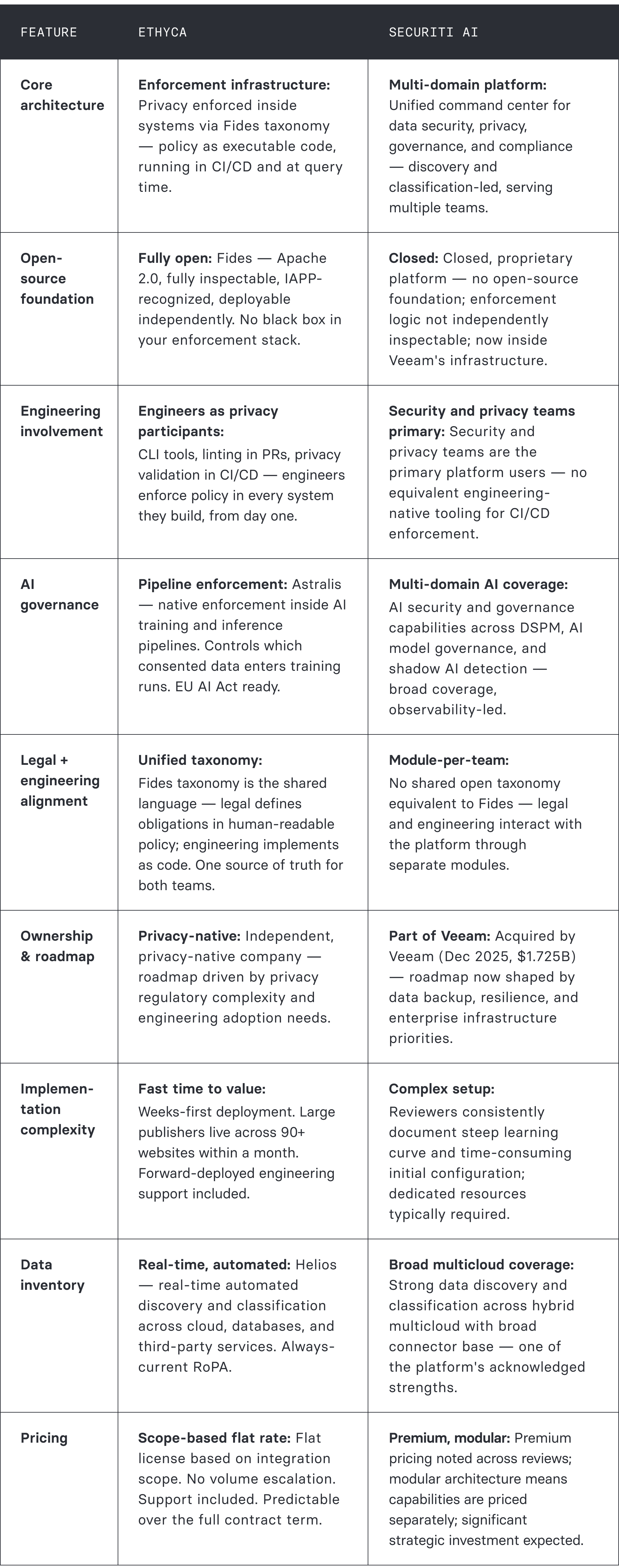
Ethyca vs. Securiti AI — side by side
Across the dimensions that determine whether your privacy program has enforcement depth or command-center breadth.
.png?w=1920&h=4863&auto=format)
Organizations that need privacy enforced inside their stack.
Data-intensive enterprises where visibility isn't sufficient — where policy needs to run inside the systems, the pipelines, and the AI models that process the data.



From command center to enforcement infrastructure.
Teams moving from Securiti AI typically have strong data inventory foundations and mature discovery workflows. The transition adds what a command center can't provide: an open standard, CI/CD-native enforcement, and a roadmap independent of enterprise infrastructure consolidation.
↳ Step 1 — Migrate your data map into Helios
Your Securiti data inventory and classification work migrates as the starting point. Helios takes over with direct system-level hooks — enriching discovery with enforcement-ready structure across internal systems and databases.
↳ Step 2 — Translate your policy framework with Fides
Privacy obligations defined in Securiti's modules translate to the Fides taxonomy — an open standard both legal and engineering teams own together. Legal definitions become machine-readable rules engineering can enforce in code.
↳ Step 3 — Move DSR fulfillment from workflow automation to system enforcement
Securiti's DSR automation routes requests through workflows. Lethe runs against actual databases — erasure and access executed at the system level, not orchestrated through a compliance workflow layer.
↳ Step 4 — Embed Fides into your engineering workflow
Fides CLI and privacy linting in pull requests means engineers enforce policy from the moment code is written. The systems they build carry compliance forward automatically — not as a discovery exercise after the fact.
↳ Step 5 — Extend AI governance to pipeline enforcement
Astralis enforces which consented data enters AI training and inference — at the pipeline level. Moving from Securiti's AI governance module to pipeline-level enforcement is the transition from compliance documentation to provable enforcement.
Apache 2.0. Fides foundation — inspectable, contributable, deployable independently. Not a module in an acquired platform
Policy runs inside systems, not in a command center above them. Engineering becomes a privacy participant from day one.
Typical deployment. Large enterprises live across 90+ websites within a month, with forward-deployed engineering support.
Pricing with support included. No MAU variables at renewal. No SKU add-ons required to reach full capability.

Common questions
Questions that surface when organizations start weighing enterprise command center breadth against privacy enforcement depth.
Securiti's breadth and enterprise credentials are real. Ethyca's evidence comes from a different angle: The New York Times (10M+ subscribers, complex global regulatory surface), Ramp (25,000+ businesses, financial data governance), Vercel, WeTransfer, and SurveyMonkey — organizations that chose infrastructure depth over platform breadth. Fides has 7,000+ GitHub stars and is IAPP-recognized. The choice isn't about credibility; it's about whether your organization needs a command center for data security, backup, and privacy together, or purpose-built enforcement infrastructure for privacy and AI governance specifically.
It's worth thinking through. Veeam is a $2B+ data backup and resilience company — a legitimate enterprise with a clear market. The combined roadmap is explicitly positioned around data backup, security, governance, and AI trust unified. That's a coherent story for a CISO consolidating data infrastructure vendors. For a Chief Privacy Officer or Head of Privacy Engineering whose primary challenges are regulatory enforcement, legal-engineering alignment, and AI pipeline governance, the question is whether those needs will drive roadmap priority inside a platform where backup and resilience are the core product identity.
Securiti's discovery and classification depth is genuinely strong — particularly across hybrid multicloud with a broad connector base. Helios provides real-time automated discovery and classification with direct integration hooks into the systems it maps — feeding an always-current RoPA and enabling Lethe to run DSR fulfillment against actual databases. The distinction isn't discovery breadth; it's what happens after discovery. Securiti feeds a command center. Helios feeds enforcement — policy execution at the system level, not just a classification record in a dashboard.
Consolidation reduces vendor sprawl and creates a shared data model — real organizational benefits. The tradeoff is depth: a platform serving security, privacy, governance, and now backup and resilience simultaneously can't optimize for any one team's enforcement needs. Ethyca's focus is specifically the intersection of legal and engineering in privacy and AI governance — the Fides taxonomy both teams share, the CI/CD tooling engineers use natively, and the pipeline enforcement that makes AI governance provable rather than documented.
Ask both: "If a regulator asks us to prove that a specific privacy policy was enforced on a specific record in a specific internal database on a specific date, what do you show them?" Securiti shows a classification record, a workflow completion log, and a dashboard view of compliance status. Ethyca shows the Fides policy that ran, the data category it governed, and the enforcement record from the system itself — a log of the rule that executed, not a report of what the command center observed.