.png?w=1920&h=1008&auto=format)
Seeing a violation is not the same as preventing one.

Observability tells you what happened. Enforcement determines what can.
Relyance AI's strength is visibility — tracking data flows from source code to AI models and surfacing where policy isn't being met. Ethyca's foundation is enforcement — policy defined once, executed automatically, everywhere your data goes.
Relyance AI
Real-time data flow monitoring and security observabilityRelyance AI scans code, runtime, and infrastructure to track how sensitive data moves across an organization — identifying where data flows, what third parties receive it, and where those flows diverge from policy commitments. Its Data Journeys™ technology provides lineage from source code through cloud runtime to AI models.
The platform serves security, privacy, and AI governance teams with a unified view. Its strength is detection and surface-level visibility at scale — organizations can see their data footprint in minutes of connecting their systems, and receive alerts when flows don't match policy expectations.
→ Strong at visibility and detection across a connected environment
Ethyca
Visibility without enforcement is documentation, not controlDetecting a policy violation and preventing it are not the same operation. Relyance AI surfaces gaps — it identifies where data is flowing in ways that don't match policy. But the remediation still requires human response: a workflow triggered, an alert actioned, a developer told to fix something.
Ethyca enforces at the infrastructure level. Fides runs in CI/CD pipelines, catching policy violations before code ships. Helios maps in real time and Lethe executes against actual databases. Astralis controls which data enters AI pipelines. The policy isn't monitored — it's enforced. The difference matters when a regulator asks not just whether you had a policy, but whether it ran.
→ Enforcement means the policy ran — not just that a gap was logged

Companies building trust into data with Ethyca
Where the observability model reaches its boundary.
A platform built to monitor data flows has natural limits when the question shifts from "what happened" to "what was enforced." Those are different answers with different regulatory weight.
Detection is not prevention
Relyance AI identifies where data flows diverge from policy — it surfaces violations as they occur or after the fact. That's valuable for visibility. But the enforcement loop still depends on human response: an alert received, a ticket created, a developer fixing a gap that already existed in production. Ethyca closes the loop before code ships.
Closed platform with no shared standard
Relyance AI is a proprietary platform. There is no open-source foundation equivalent to Fides that teams can inspect, contribute to, or deploy independently. When a regulator asks how a privacy rule was implemented and enforced, the answer runs through Relyance's vendor infrastructure — not an independently auditable standard your team controls.
An expanding scope that dilutes the privacy story
Relyance AI has expanded from its privacy roots into DSPM (data security posture management) and AI security governance — serving security teams, privacy teams, and AI governance simultaneously. That breadth creates value for some organizations. It also means the product is no longer purpose-built for the specific problem of legal-engineering alignment around privacy compliance.
The question underneath all three
Relyance AI is genuinely useful for organizations that need visibility into where data is flowing across a complex, connected infrastructure. But visibility is the starting point, not the outcome. When a regulator, auditor, or board asks whether your privacy policy was enforced — not monitored, enforced — the answer requires more than a detection log. It requires proof that policy ran at the system level. That's what Ethyca is built to provide.
Relyance AI is proprietary. Ethyca's foundation is open.
Fides is the world's most widely used open-source privacy engineering standard. There is no Relyance equivalent — their platform, enforcement logic, and audit trails are all vendor-mediated. When the question is whether a policy was enforced, not just detected, that distinction carries regulatory weight.
7k+ GitHub stars
Actively maintained, community-contributed, and deployable independently of Ethyca's commercial platform. Every enforcement decision can be inspected by your team.
Apache 2.0
Open license No vendor lock-in on the taxonomy itself. Your privacy standard is yours — built on an open specification that DataGrail cannot match with a closed product.
IAPP
Recognized standard Fides is recognized by the International Association of Privacy Professionals as a governance standard — not a vendor tool, but a shared language the entire industry can use.
.png?w=3200&h=1800&auto=format)
"By adopting Ethyca's infrastructure, we're unifying privacy, legal, and engineering around a single source of truth, enabling us to manage data responsibly and confidently as we expand globally." ”— Director of CRM & Lifecycle Marketing · JustPark
Relyance AI vs. Ethyca — side by side
Across the dimensions that determine whether your privacy program can prove enforcement, not just visibility, under regulatory scrutiny.
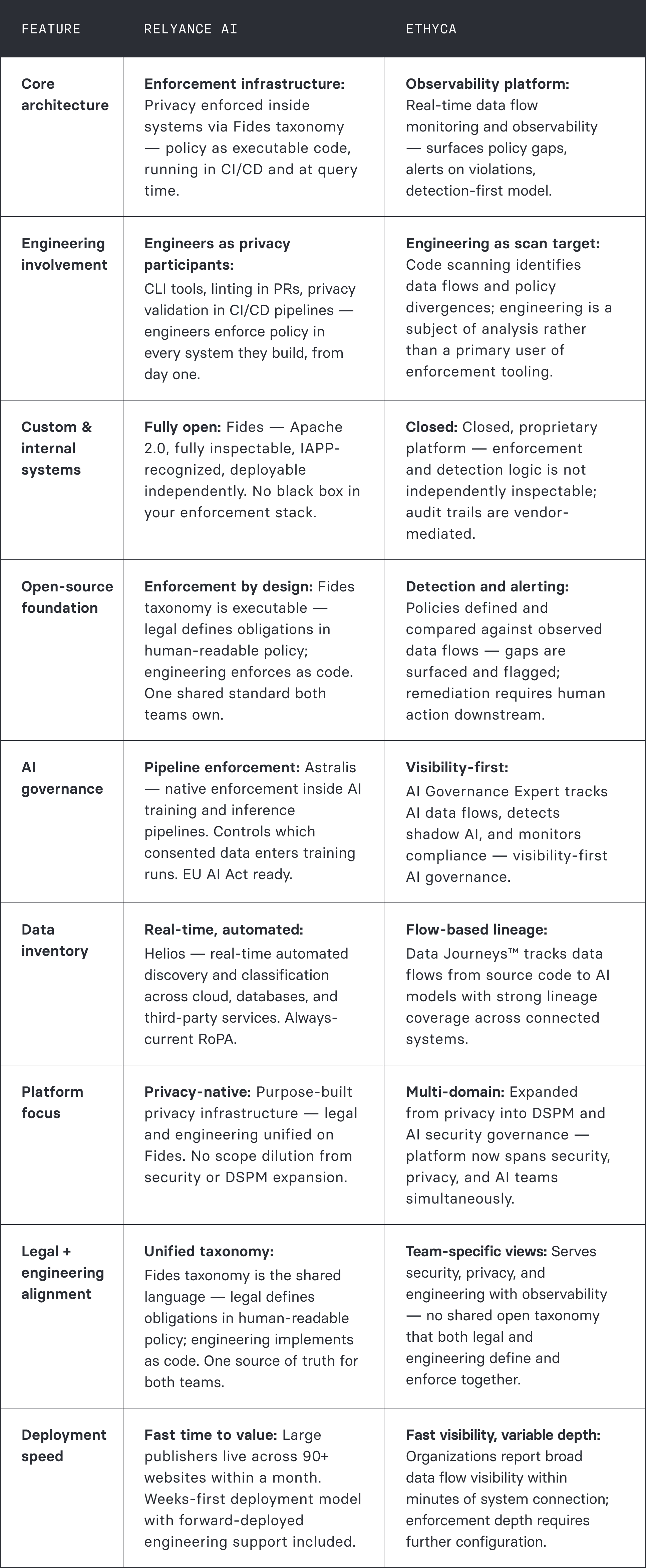.png?w=1920&h=4659&auto=format)
Organizations that need privacy enforced inside their stack.
Data-intensive enterprises where visibility isn't sufficient — where policy needs to run inside the systems, the pipelines, and the AI models that process the data.




From visibility to enforcement.
Teams moving from Relyance AI have typically built a strong picture of their data flows. The transition is additive — that visibility foundation is complemented with enforcement at the system and pipeline level, an open taxonomy, and engineering-native tooling.
↳ Step 1 — Map your Relyance data lineage into Helios
Your existing data flow and inventory knowledge from Relyance migrates as a starting point. Helios takes over real-time classification with direct hooks into internal systems and databases — enriching lineage with enforcement-ready structure.
↳ Step 2 — Translate your policy definitions with Fides
Policy commitments mapped in Relyance translate to the Fides taxonomy — the open standard both legal and engineering teams share. Legal obligations become machine-readable rules that engineering can implement and enforce.
↳ Step 3 — Shift from alerting to enforcement at the system level
Relyance surfaces policy gaps after data has moved. Lethe runs against actual databases to fulfill DSR requests directly. Fides in CI/CD catches violations before code ships — enforcement replaces detection at every stage.
↳ Step 4 — Embed Fides into your engineering workflow
Engineering teams install the Fides CLI and add privacy linting to pull requests. Every system they build enforces policy from day one — not discovered and alerted on after the fact.
↳ Step 5 — Extend AI governance from visibility to pipeline enforcement
Astralis enforces which consented data can enter AI model training and inference pipelines — at the pipeline level, in compliance with the EU AI Act. The transition from monitoring AI data flows to governing them directly.
Typical deployment timeline. Large enterprises live across 90+ websites within a month, with forward-deployed engineering support included.
Policy runs before data moves, not after. Violations are caught in CI/CD, not surfaced in a monitoring dashboard.
Apache 2.0 foundation. Fides is inspectable, contributable, and deployable independently. No vendor lock-in on the standard itself.
Pricing with support included. No MAU variables at renewal. No SKU add-ons required to reach full capability.

Common questions
Questions that surface when teams start drawing the line between monitoring what's happening and enforcing what should.
Real-time data flow visibility is genuinely valuable — knowing where data is moving, whether third parties are receiving what they should, and where flows diverge from policy is important. The question is what happens after you know. Relyance surfaces the gap. Ethyca's approach is to close it before it opens: Fides runs in CI/CD so policy violations are caught at build time, before code ships. Helios maps in real time with enforcement hooks, not just observation. The difference is between knowing a pipe is leaking and having a system that prevents it from leaking.
Platform consolidation has real organizational value — fewer vendors, a unified dashboard, a shared data model across teams. The tradeoff is depth in each domain. Relyance expanded from privacy into DSPM and AI security, which means its privacy program features compete for roadmap priority alongside security use cases. Ethyca is purpose-built for the specific problem of legal-engineering alignment around privacy and AI governance. For organizations where the primary challenge is making privacy enforceable across legal and engineering — not observing data flows across security and privacy simultaneously — that focus matters.
Helios provides real-time automated data discovery and classification across cloud, databases, and third-party services — always-current mapping that feeds directly into an audit-ready RoPA. The distinction from Relyance's lineage approach is depth vs. breadth: Helios maintains direct integration hooks into the systems it maps, enabling Lethe to run DSR fulfillment against actual databases rather than routing through integrations. Relyance's strength is broad flow-level visibility across a connected graph; Ethyca's is enforcement-ready mapping with system-level depth.
Relyance AI Governance Expert tracks AI data flows, detects shadow AI, and monitors for compliance with AI policies — strong visibility into what AI is doing with data. Ethyca's Astralis enforces at the pipeline level: it controls which consented data can enter a training run or inference call, under what conditions, in compliance with the EU AI Act. That's the difference between knowing that training data might include non-consented personal data and having a system that prevents it. For organizations facing EU AI Act obligations where documentation needs to show enforced controls, not monitored observations, that distinction is material.
Ethyca's customer evidence is concentrated in organizations with particularly demanding privacy compliance requirements: The New York Times (10M+ subscribers across 200 countries), Ramp (25,000+ businesses, financial data with strict governance obligations), WeTransfer, SurveyMonkey, Vercel, and American City Business Journals (40+ media properties). Fides has 7,000+ GitHub stars and is IAPP-recognized as an industry governance standard — not a vendor tool, but a shared infrastructure specification the engineering community has validated independently.
Ask both: "If a regulator asks us to prove that a specific privacy policy was enforced — not monitored, enforced — on a specific record in a specific internal database on a specific date, what do you show them?" Relyance AI shows you a data flow visualization and an alert log indicating a gap was or was not detected. Ethyca shows you the Fides policy that was applied, the data category it governed, and the enforcement record from the system itself — a log of the rule that ran, not a dashboard of the observation. That question is the clearest signal of whether you have observability or infrastructure.