
Consent ≠ Privacy Infrastructure

Capturing consent at the banner is not the same as enforcing it in the system.
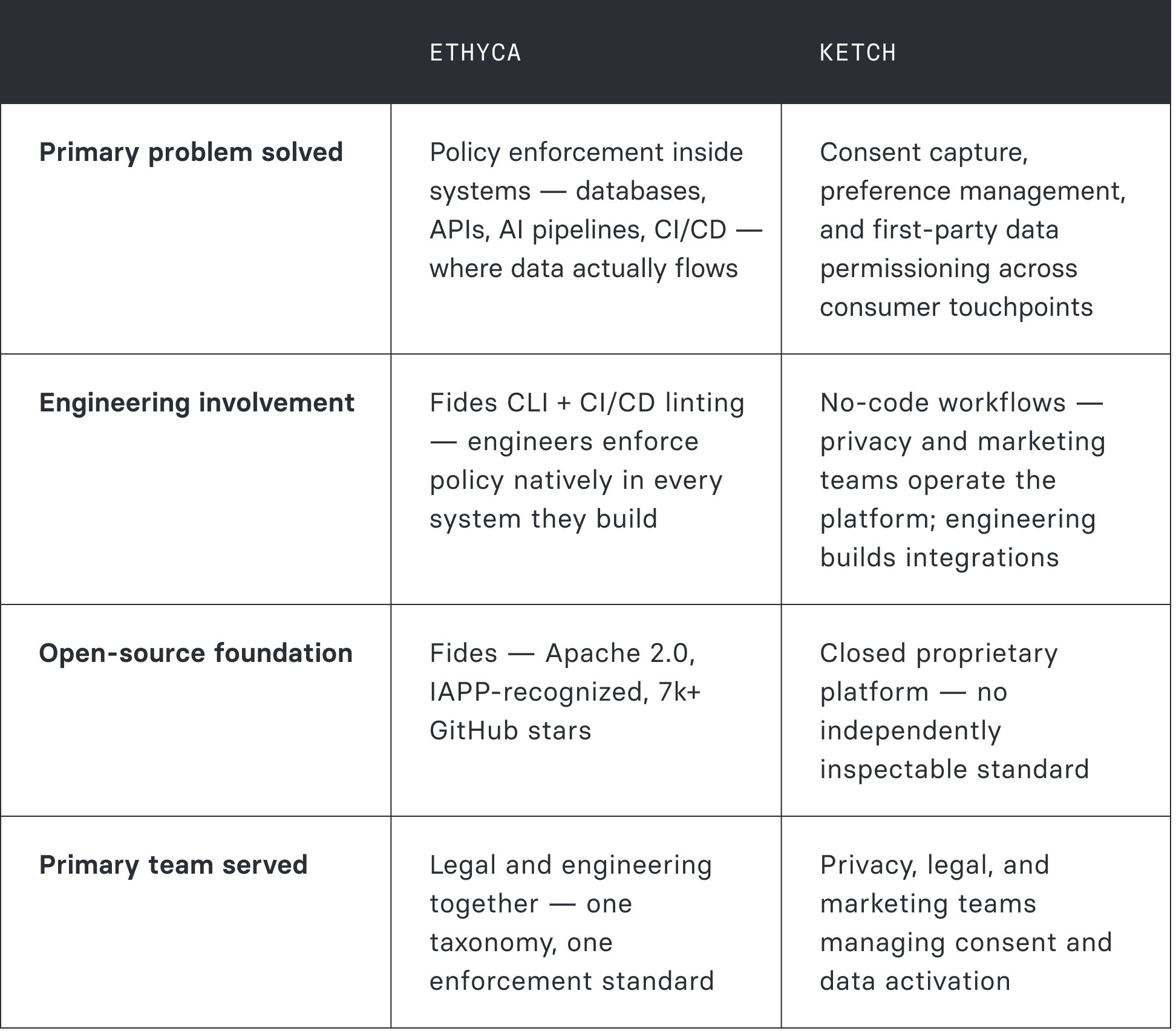
Ketch is designed to manage what users choose and activate compliant data for marketing and advertising. Ethyca is designed to enforce that those choices are respected inside every system that processes the data — at the database, pipeline, and code level.
Ketch
Consent management and data permissioning for privacy and marketing teamsKetch's strength is the consumer-facing consent and preference layer — adaptive banners, progressive consent embedded in digital journeys, DSR automation with no-code workflow builders, and first-party data activation across marketing platforms. Its focus on privacy-as-growth-lever resonates with marketing and privacy teams who want consent to drive better data, not just compliance checkboxes.
For organizations where the primary challenge is consent UX, first-party data collection, and multi-regulation compliance banner management, Ketch is purpose-built for those problems. Its customization capabilities and consumer-facing experience design are genuine differentiators.
→ Strong consent UX, first-party data activation, and no-code DSR automation
Ethyca
Permissioned data still needs to be governed inside the systems that use itKetch captures consent and manages preferences. But between the consent banner and the AI model, the database query, or the marketing pipeline, there are many systems where that consent signal needs to be enforced — not just stored. When engineering builds new data processing logic, they have no Ketch tooling to ensure it respects the permission. The consent is captured. The enforcement is a separate problem.
Ethyca's Fides taxonomy creates the shared standard between what consent was given and what systems are allowed to do with it. Engineers enforce it in CI/CD. Lethe executes DSR requests against actual databases. Astralis controls which consented data enters AI training. Ketch manages the permission. Ethyca enforces it at the infrastructure level.
→ Consent captured is not consent enforced
.png?w=1920&h=1683&auto=format)
Companies building trust into data with Ethyca
Where a consent platform reaches its boundary.
A platform built to manage consumer preferences and activate permissioned data has natural limits when the question shifts from "did we capture consent?" to "was that consent respected inside our systems?"
Consent captured is not consent enforced at the system level
Ketch collects and stores consent signals and activates them to marketing platforms. It doesn't enforce them inside proprietary databases, internal applications, or AI pipelines. When engineering builds a new system that processes user data, there's no Ketch mechanism to ensure it honors the consent signal. The gap between "preference stored" and "preference enforced across all systems" is where Ethyca operates.
No engineering-native enforcement tooling
Ketch is designed for privacy and marketing teams to operate without engineering. That works for managing banners and DSR workflows. It means engineers have no privacy tooling — no CLI, no CI/CD linting, no way to enforce policy in the code they write. Every system engineers build is privacy coverage that has to be connected to Ketch after the fact, through integration work.
AI governance is a compliance gap, not a strength
Ketch's AI governance capabilities center on regulatory compliance frameworks and consent for AI use cases. There is no equivalent to Astralis — enforcement at the pipeline level that controls which consented data enters AI training and inference runs. As organizations face EU AI Act obligations requiring proof that training data was properly consented, a consent management platform's documentation layer is insufficient.
The structural gap
Ketch and Ethyca address adjacent layers of the same problem. Ketch manages what users choose. Ethyca enforces that choice inside the systems that process data on users' behalf. For organizations where those two layers are already well-separated — consent management handled, infrastructure enforcement needed — the question isn't whether Ketch is good. It's whether it addresses the layer where the compliance risk actually lives.
Ketch is proprietary. Ethyca's foundation is open.
Ketch is a closed platform — consent signals, data maps, and audit trails are all vendor-mediated. Fides is the world's most widely used open-source privacy engineering standard: inspectable, contributable, and deployable independently. When you need to prove that consent was honored inside a specific system on a specific date, that distinction matters.
7k+ GitHub stars
Actively maintained, community-contributed, and deployable independently of Ethyca's commercial platform.
Apache 2.0
Open license. The enforcement standard is yours. Ketch can't offer an open equivalent.
IAPP
Recognized standard. Recognized by the IAPP as a governance standard — shared taxonomy across the industry, not a vendor-specific schema.
.png?w=3200&h=1800&auto=format)
"By adopting Ethyca's infrastructure, we're unifying privacy, legal, and engineering around a single source of truth, enabling us to manage data responsibly and confidently as we expand globally."”— Director of CRM & Lifecycle Marketing · JustPark
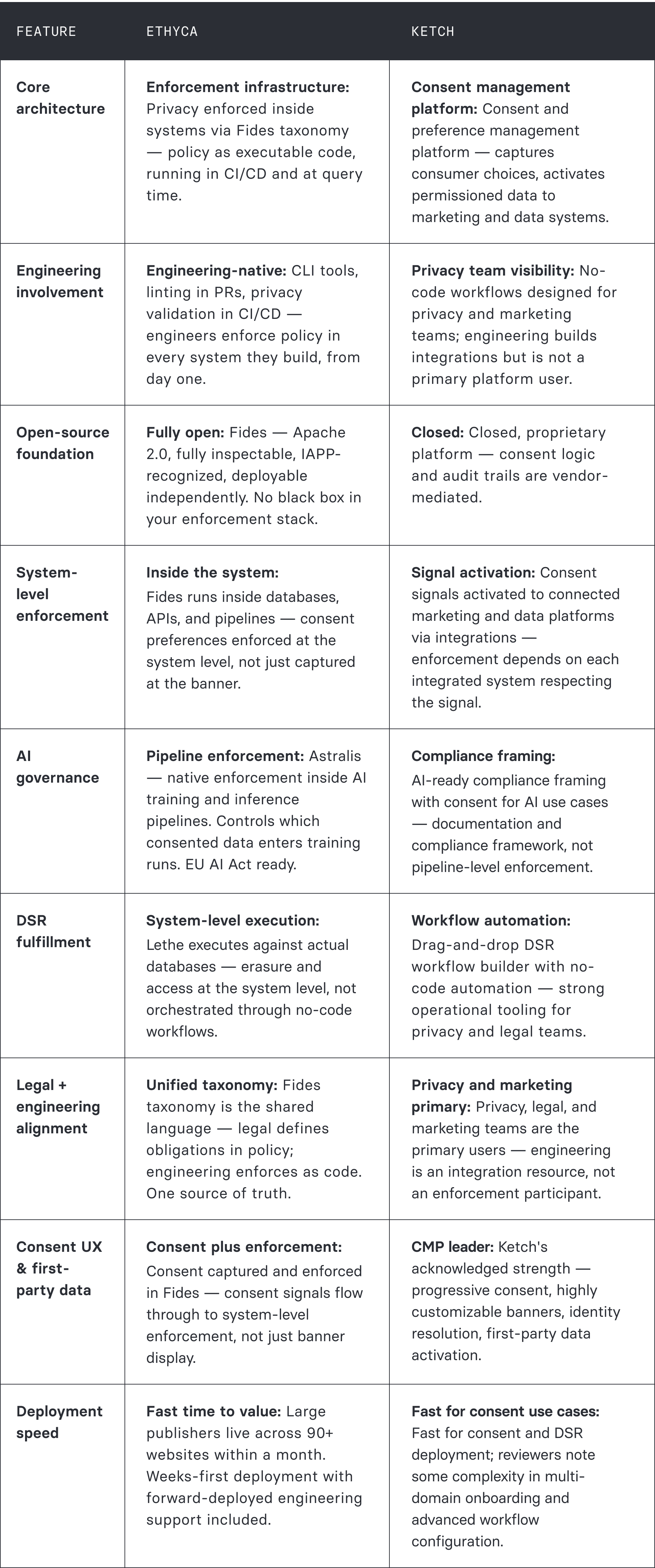
Ethyca vs. Ketch — side by side
Across the dimensions that separate consent management from privacy infrastructure.
.png?w=1920&h=4594&auto=format)
Organizations that need consent enforced, not just captured.
Enterprises where the gap between "consent stored" and "consent respected in every system" is material — where legal and engineering need infrastructure that closes the loop.






From consent management to enforcement infrastructure.
Teams moving from Ketch have typically built strong consent capture workflows. The transition is additive — that consent foundation is preserved and extended with system-level enforcement, engineering-native tooling, and AI pipeline governance.
↳ Step 1 — Migrate your consent configuration with Fides
Existing consent categories and user preferences from Ketch migrate to the Fides taxonomy — the open standard both legal and engineering share. Consent signals that Ketch captured become enforceable policies in Fides, applied at the system level rather than activated to marketing platforms.
↳ Step 2 — Extend consent enforcement into your systems
Fides connects consent to the databases, APIs, and pipelines that process user data — enforcing the preference at the system level, not just at the banner. Users' choices stop being a signal stored by Ketch and start being a rule enforced in every system that touches their data.
↳ Step 3 — Replace workflow-based DSR with system-level fulfillment
Ketch's no-code DSR workflow automation routes requests through integrations. Lethe executes against actual databases — erasure and access at the system level. Fulfillment becomes faster, more auditable, and less dependent on integration chains being correctly configured.
↳ Step 4 — Embed Fides into your engineering workflow
Fides CLI and privacy linting in pull requests means engineers enforce the consent policy in every system they build. The privacy program stops being a marketing and legal tool and becomes a property of the codebase itself.
↳ Step 5 — Extend to AI pipeline governance with Astralis
Astralis enforces which consented data can enter AI training and inference runs — closing the gap between consent captured at the banner and consent honored in the AI models that learn from users' data.
Apache 2.0. Fides. The shared standard legal and engineering both own. Consent logic is yours, not Ketch's.
Consent respected inside systems, not just stored in a platform. Policy runs where data flows.
Typical deployment. Large enterprises live across 90+ websites within a month, with forward-deployed engineering support.
Pricing with support included. No separate support fee, no modular add-ons required to reach full-platform capability.

Common questions
What teams considering Ketch ask us.
If consent UX, adaptive compliance banners, and first-party data activation for marketing are the primary problems, Ketch is genuinely well-suited to them. Where the question gets more complex: once consent is captured, what enforces that signal inside your databases, APIs, and AI pipelines? Ketch activates consent to the marketing platforms you've integrated. It doesn't enforce consent in the internal systems engineers build. Ethyca's Fides closes that gap — connecting the consent signal to the system-level enforcement layer. The two platforms address adjacent problems; which one you need depends on where your current gap actually is.
Ketch's customer support reputation and operational ease are real strengths. No-code workflows for privacy teams reduce operational friction meaningfully. The tradeoff is that when engineering isn't equipped with privacy tooling, every system engineers build requires post-hoc integration work. Ethyca's approach gives engineers the tools directly — Fides CLI, CI/CD linting — so the privacy program grows with the engineering team rather than running behind it.
Yes. Ethyca includes consent banner management, preference centers, and consent orchestration as part of the Fides platform — including multi-regulation support and consent configured as a clear site × region × experience grid across large property footprints. The distinction from Ketch is that Ethyca's consent is integrated with enforcement at the system level. Consent signals captured by Fides flow directly into the enforcement layer — Fides policies, Lethe DSR execution, and Astralis AI pipeline governance. It's not consent-as-marketing-activation; it's consent-as-system-enforcement.
Ask both: "If a user withdraws consent for a specific data processing purpose, how does your platform ensure that consent withdrawal is honored inside our internal databases and AI training pipelines — not just reflected in the banner?" Ketch's answer involves updating the consent record, deactivating data to connected marketing platforms, and DSR workflow automation. Ethyca's answer: the Fides policy governing that data purpose is updated, Lethe executes the deletion or restriction at the database level, and Astralis enforces the withdrawn consent in AI pipeline access controls. That question reveals whether you have preference management or infrastructure enforcement.